
Probing Crossmodal Brain Development
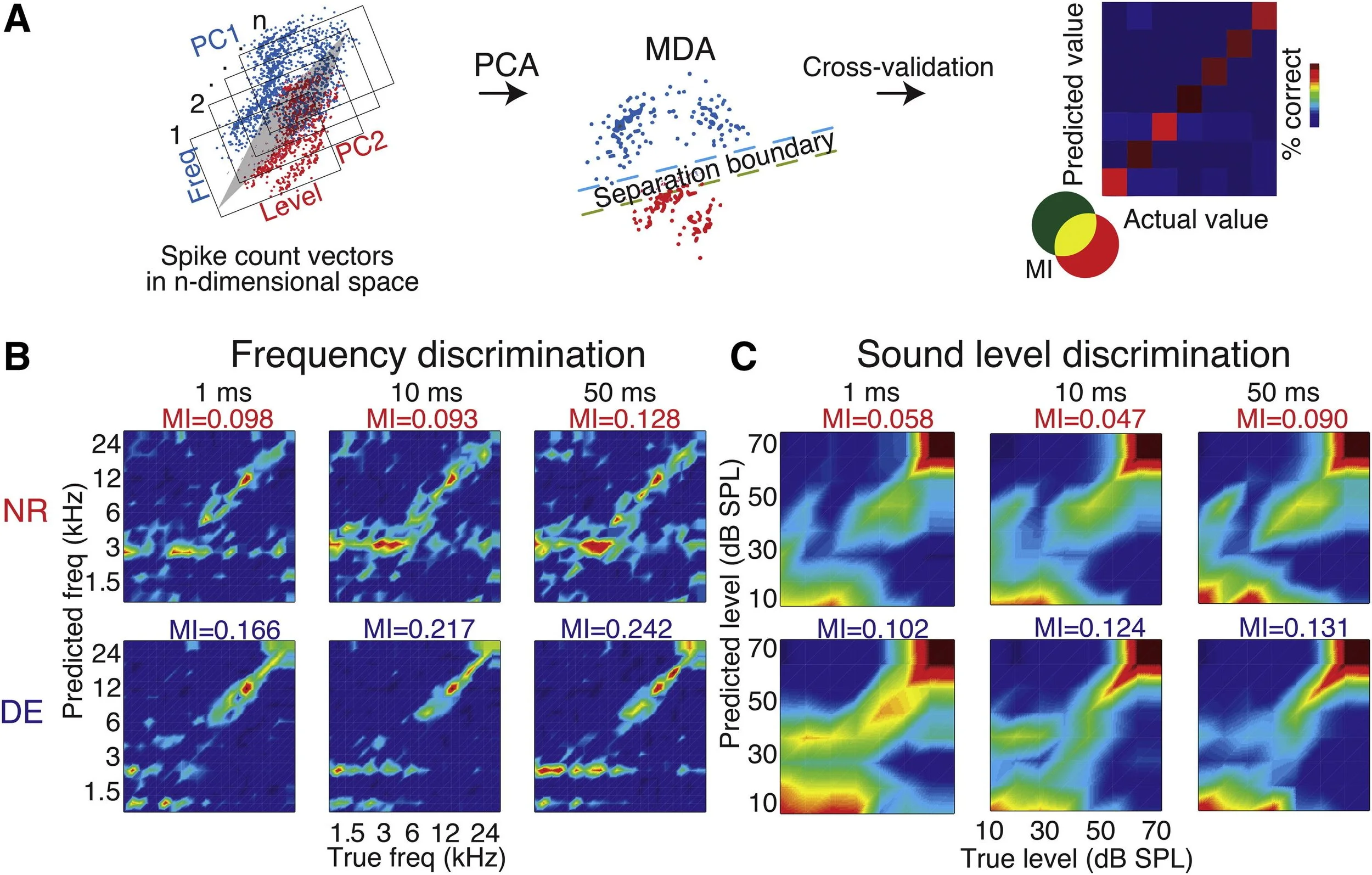
How well do auditory neurons encode sound — and does early hearing loss change that? Panel A explains the analytical approach. Each time a neuron fires in response to a sound, it produces a pattern of electrical activity. By collecting these patterns across many repetitions of the same sound, the researchers could ask: how consistently and distinctly does this neuron respond to different sounds? To answer this, they used a classification algorithm that attempts to match each observed response pattern to the correct sound — the right frequency (pitch) or the right loudness level. Performance is summarized in a confusion matrix: a grid where correct identifications fall along the diagonal and errors appear off it. The better the neurons encode sound, the more tightly the results cluster along that diagonal. The overall quality of encoding is then summarized as a single number — mutual information — which captures how much the neural response actually tells you about what sound was played. Panel B asks whether early hearing deprivation changes how precisely auditory cortex neurons distinguish between different pitches. Confusion matrices are shown for both normally raised animals and those raised with early hearing deprivation, at three different levels of temporal precision. The results show that early deprivation improves frequency discrimination — the neurons of deprived animals more reliably assigned the correct pitch to each response pattern, reflected in tighter diagonal alignment and higher mutual information scores. The strongest performance in both groups was concentrated near each group's characteristic frequency — the pitch each neuron is naturally most sensitive to. Panel C asks the same question for loudness rather than pitch. Again, early deprivation increased the accuracy with which neurons distinguished between different sound levels, with mutual information improving consistently across the range tested. One notable pattern: discrimination performance plateaued at sound levels above approximately 60 dB — suggesting a ceiling effect at higher intensities regardless of rearing condition.
Subplate Neurons and Cortical Responses
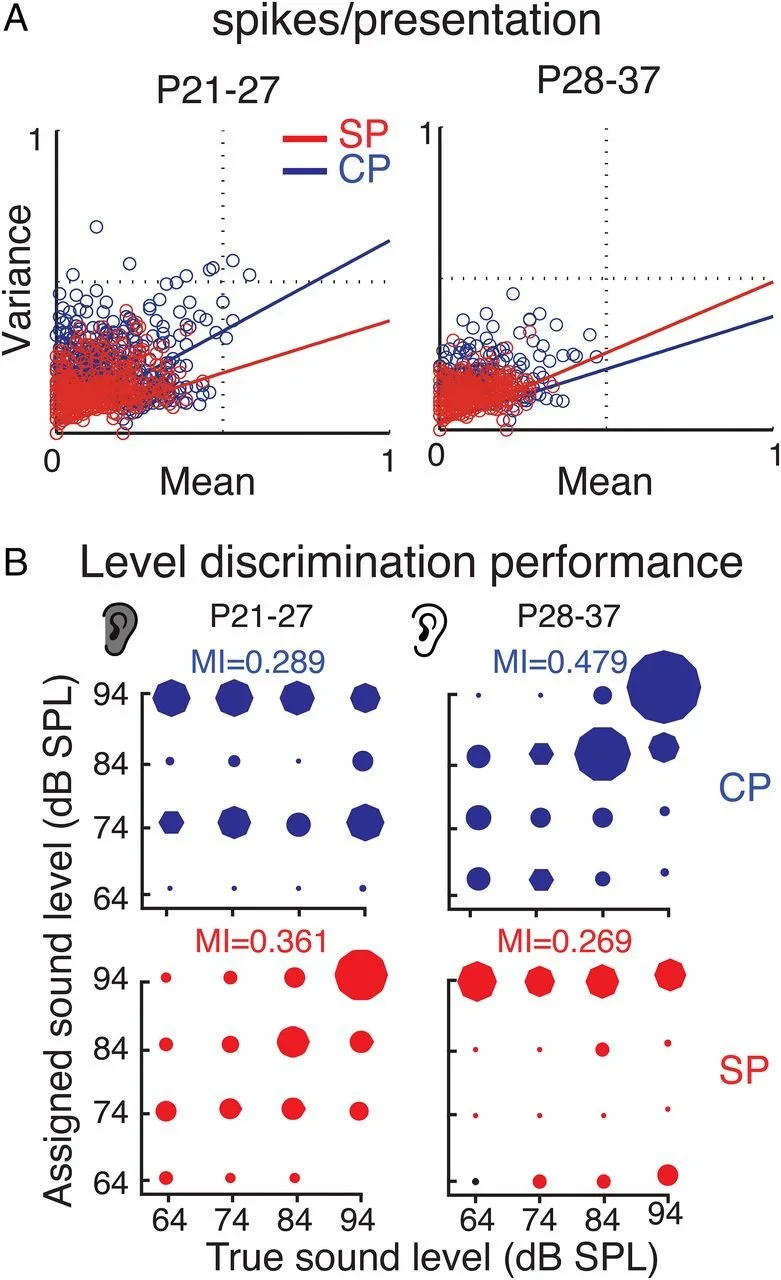
Two types of auditory neurons develop reliability at different rates: Panel A compares how consistently two types of neurons fire in response to the same sound played repeatedly. Subplate (SP) neurons sit deep in the developing brain and are among the earliest neurons to form — they receive incoming signals from the thalamus before the main cortical layers are fully wired up. Cortical plate (CP) neurons are the neurons of the mature cortical layers that eventually take over this role. Reliability here is measured as the ratio of variability to average firing rate — lower values mean more consistent responses. At young ages, SP neurons are the more reliable of the two. With age, this relationship reverses — CP neurons become the more consistent responders, reflecting the gradual maturation of the permanent cortical circuitry. Panel B shows how well each neuron type can distinguish between sounds of different loudness levels at each age. Using the same classification approach described previously, neural responses were matched to the correct loudness level, and mutual information was calculated to summarize overall encoding quality. The confusion matrices confirm that SP neurons classify sound level more accurately at young ages — consistent with their greater response reliability seen in panel A, and with their proposed role as the brain's earliest functional sensory processors before mature thalamocortical connections to the cortical plate are established.