
Behavioral Model of Bilateral Cochlear Implantation
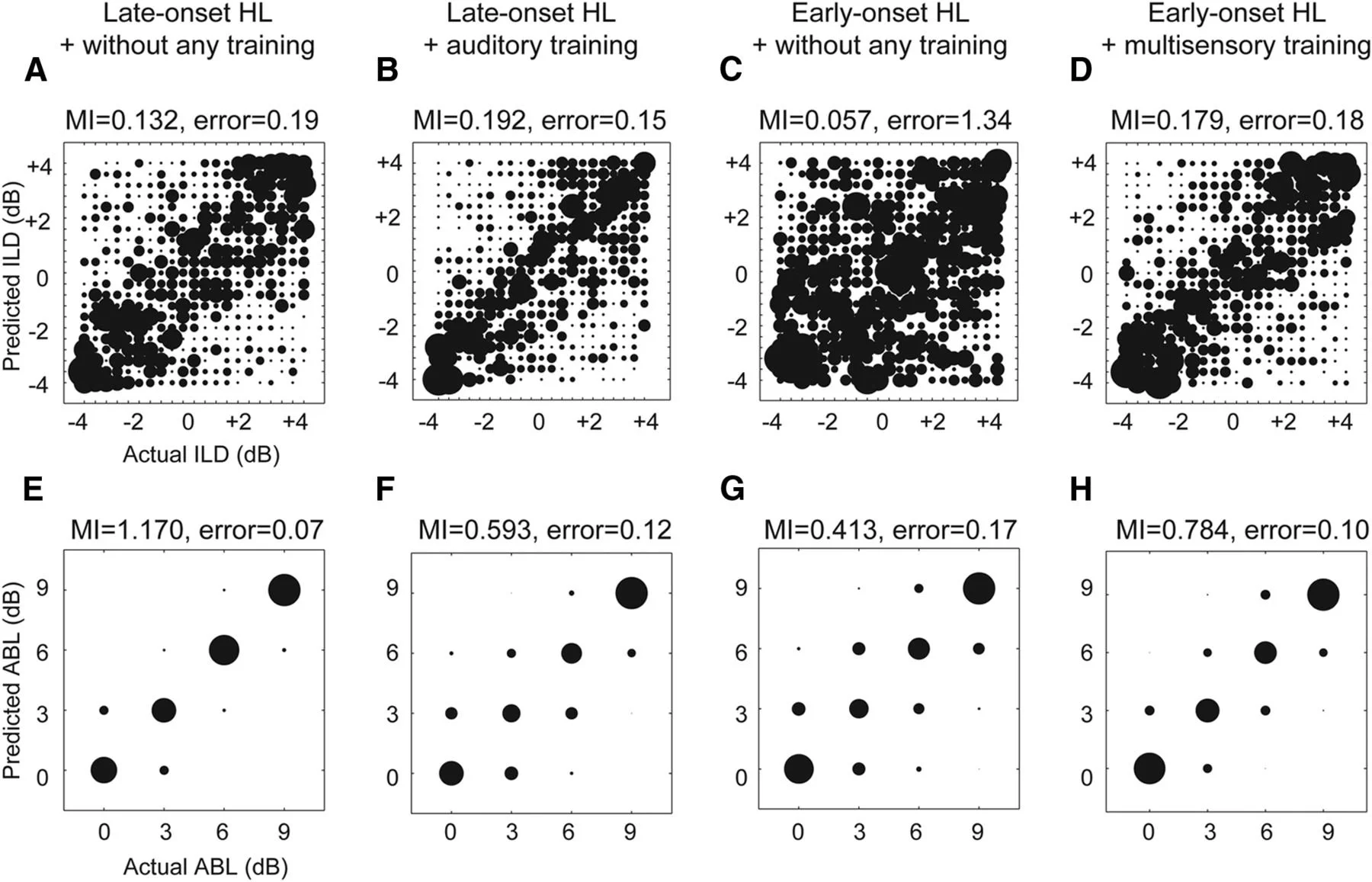
How well do auditory cortical neurons encode spatial sound cues — and does early deafness or cochlear implant training change that? This figure asks whether the brain's ability to process two key properties of sound — where it is coming from (encoded as the difference in sound level between the two ears, or ILD) and how loud it is overall (average binaural level, or ABL) — is affected by when hearing loss occurred and whether the animal received training after receiving cochlear implants (CIs). Results are shown as bubble plots, where each bubble represents how often a given sound was assigned a particular identity by the classifier; bubbles clustered along the diagonal indicate accurate encoding, while bubbles scattered off it indicate errors. Panels A–D: Spatial sound coding (ILD) Panel A shows animals that lost hearing as adults and received CIs without any training. Panel B shows animals with late-onset hearing loss who received CIs and then underwent auditory training. Both groups showed reasonably accurate ILD coding, reflected in tighter diagonal clustering. Panel C shows animals that lost hearing early in life, received CIs as adults, but had no training. These animals showed poor spatial sound coding — bubbles were widely scattered off the diagonal, and both the number and magnitude of classification errors were large. This suggests that early hearing deprivation, without subsequent rehabilitative training, leaves the auditory cortex poorly equipped to use the spatial information delivered by CIs. Panel D shows animals with the same early hearing loss and late CI placement, but who received auditory training followed by multisensory training. Classification accuracy improved substantially, indicating that training can partially rescue the spatial coding deficits caused by early deafness. Panels E–H: Overall loudness coding (ABL). The same four groups are shown for ABL coding. Mutual information scores above each panel quantify encoding quality. Results across groups allow comparison of whether the effects of early deafness and CI training are specific to spatial processing or extend to basic loudness encoding as well.